
JAMstack vs Traditional Web Development in 2026: Which Architecture Wins for Speed, SEO, and Scalability?
Web development has changed more in the last five years than it did in the previous fifteen.
We’ve moved from shared hosting and monolithic PHP apps to edge computing, serverless functions, headless CMS, and hybrid rendering models. Frameworks like Next.js and platforms like Vercel have completely reshaped how modern websites are built and deployed.
But one debate still comes up in almost every serious tech discussion:
JAMstack vs Traditional Web Development — which one actually makes sense in 2026?
If you’re a:
- Frontend developer
- Full-stack developer
- Freelancer building client projects
- Agency owner scaling production
- Founder launching a SaaS
- Or a beginner choosing what to learn
This article will give you a practical, no-fluff answer.
No hype. No buzzwords. Just what works in the real world.
First, Let’s Clear the Confusion
Before comparing them, let’s define both properly.
What is JAMstack?
JAMstack stands for:
- JavaScript
- APIs
- Markup
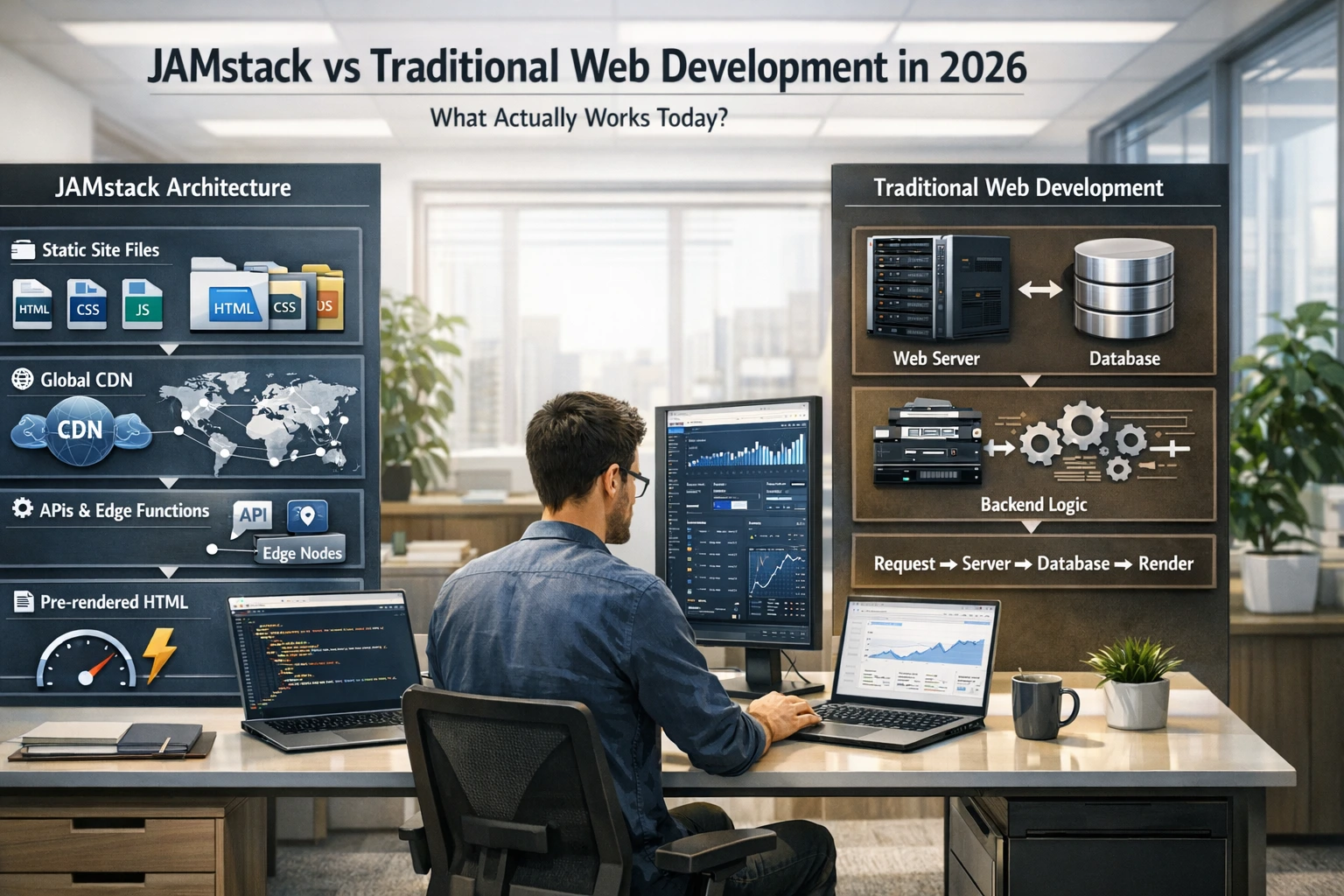
The term was popularized by Netlify to describe a modern web architecture where:
- Pages are pre-rendered (static generation)
- Frontend is decoupled from backend
- Dynamic features are handled via APIs
- Deployment happens on global CDNs
Instead of generating HTML on every request, the site is built once and served instantly from the edge.
Popular JAMstack frameworks in 2026 include:
- Next.js
- Nuxt.js
- Astro
- Gatsby
What is Traditional Web Development?
Traditional web development typically follows a monolithic structure:
- Backend + frontend tightly connected
- Server renders HTML on every request
- Database queries run per page load
- Everything lives on a server
Common traditional frameworks include:
- Laravel
- Django
- Ruby on Rails
- ASP.NET
This model has powered the web for decades — and it still powers a huge part of it today.
The Real Difference: How They Think About Rendering
Here’s where the philosophies split.
Traditional Model:
User → Server → Database → Render → Send HTML
Every request triggers backend logic.
JAMstack Model:
Build Time → Generate HTML → Deploy to CDN → Serve instantly
No heavy processing per request.
That architectural difference changes everything — from speed to scaling.
Performance in 2026: Speed Isn’t Optional Anymore
In 2026, speed isn’t a “nice to have.”
It directly impacts:
- SEO rankings
- Conversion rates
- Bounce rates
- Ad performance
- User trust
Why JAMstack Feels Faster
Because most pages are pre-built:
- No database call on load
- No server processing delay
- Delivered via edge networks
When deployed on platforms like Vercel or Netlify, content is served from locations closest to users.
Result?
Sub-second load times.
For blogs, marketing sites, landing pages — JAMstack usually wins on raw speed.
Can Traditional Be Fast?
Yes. But it requires:
- Caching layers
- CDN configuration
- Database optimization
- Server tuning
- DevOps management
Traditional apps can be fast — but it takes effort.
JAMstack is fast by default.
That’s the difference.
SEO: Which One Ranks Better?
Here’s the honest truth:
Google doesn’t care what stack you use.
It cares about:
- Page speed
- Core Web Vitals
- Mobile usability
- Structured data
- Clean HTML
JAMstack gives you an advantage because:
- HTML is pre-rendered
- Pages load quickly
- Performance metrics are easier to optimize
But traditional SSR (server-side rendering) also produces crawlable HTML.
Frameworks like Next.js now support:
- Static Site Generation (SSG)
- Server-Side Rendering (SSR)
- Incremental Static Regeneration (ISR)
Which means the line between JAMstack and traditional is getting blurred.
SEO winner?
It depends on implementation quality — not the label.
Security: A Big Shift in 2026
Security threats have increased. So has complexity.
JAMstack Security Advantage
- No open database by default
- Fewer exposed servers
- Reduced attack surface
- Static files are harder to exploit
Because the frontend is separated, many traditional vulnerabilities disappear.
Traditional Risks
- SQL injection
- Server exploits
- Misconfigured permissions
- Plugin vulnerabilities
Of course, traditional apps can be secure — but they require active monitoring.
For small teams and agencies, JAMstack reduces risk significantly.
Scalability: Handling Traffic Spikes
Let’s say your blog goes viral.
Or your startup launches on Product Hunt.
What happens?
JAMstack
Because it’s served from CDN:
- It scales automatically
- No server crash
- No database overload
You don’t need to panic.
Traditional
You may need:
- Load balancers
- Server upgrades
- Horizontal scaling
- Cloud auto-scaling
It works — but it’s more complex.
If you expect unpredictable traffic, JAMstack is safer.
Cost Comparison in 2026
This matters a lot for freelancers and agencies.
JAMstack Cost
- Hosting often free or cheap
- Serverless functions pay-per-use
- CDN included
- Lower maintenance cost
For content-driven websites, it’s extremely economical.
Traditional Cost
- VPS or dedicated server
- Ongoing maintenance
- DevOps
- Database hosting
It can scale well — but infrastructure cost grows with complexity.
If you’re building simple marketing or content sites, JAMstack usually costs less.
Developer Experience (DX)
This is where opinions vary.
JAMstack Developer Experience
Pros:
- Clean separation of concerns
- Git-based workflows
- CI/CD pipelines
- Modern JavaScript ecosystem
Cons:
- API integrations can become complex
- Debugging distributed systems isn’t always simple
Traditional Developer Experience
Pros:
- Everything in one place
- Strong ORM systems
- Mature ecosystems
- Clear backend logic
Cons:
- Scaling complexity
- Server management
If you enjoy backend architecture and database modeling, traditional may feel more natural.
If you prefer frontend-heavy development with APIs, JAMstack feels lighter.
Where JAMstack Clearly Wins in 2026
JAMstack is ideal for:
- Blogs
- Documentation websites
- SaaS marketing pages
- Landing pages
- Portfolio websites
- E-commerce frontends (headless model)
- Startup MVPs
Especially when paired with:
- Headless CMS
- Serverless functions
- Edge deployment
For agencies building 10–20 client sites per year, JAMstack improves profit margins and reduces hosting headaches.
Where Traditional Still Dominates
Let’s be realistic.
Traditional stacks are still better for:
- Enterprise ERP systems
- Banking platforms
- Complex admin dashboards
- Deep relational databases
- Internal business software
- Real-time data-heavy apps
If your application depends heavily on backend workflows, role management, and complex business logic — traditional architecture remains powerful.
Frameworks like Laravel and Django are far from outdated.
They’re stable, mature, and battle-tested.
The Hybrid Model: The Real Winner
In 2026, the smartest teams don’t choose extremes.
They combine both.
Using frameworks like Next.js, you can:
- Pre-render static pages
- Dynamically render dashboards
- Use APIs for business logic
- Deploy globally via edge
This hybrid approach gives:
- Performance
- Flexibility
- SEO strength
- Backend power
And that’s why it’s becoming the default choice.
If You’re a Beginner: What Should You Learn?
Start with fundamentals:
- HTML
- CSS
- JavaScript
Then:
- React
- Next.js
Once comfortable, explore backend concepts:
- APIs
- Databases
- Authentication
- Traditional frameworks
The market in 2026 favors developers who understand both frontend and backend principles.
If You’re a Freelancer or Agency Owner
Here’s practical advice:
For marketing sites and blogs → Use JAMstack.
For complex custom apps → Use traditional or hybrid.
Why?
Because speed + SEO = higher client satisfaction.
And fewer server issues = fewer midnight calls.
So, Which Is Better in 2026?
Here’s the honest answer:
There is no universal winner.
But there is a smarter mindset.
Use JAMstack principles when:
- Speed matters
- SEO matters
- Content dominates
- Budget is limited
Use traditional architecture when:
- Backend logic is heavy
- Database relationships are complex
- You need deep server control
And when possible?
Use a hybrid approach.
Final Thoughts
The JAMstack vs Traditional Web Development debate isn’t about right or wrong anymore.
It’s about:
- Project goals
- Team skillset
- Business model
- Scalability needs
- Long-term maintenance
In 2026, the most successful developers aren’t loyal to a stack.
They’re loyal to outcomes.
Speed. Stability. Scalability. Security.
Understand both architectures.
Use the right one for the right problem.
That’s what separates average developers from professionals.